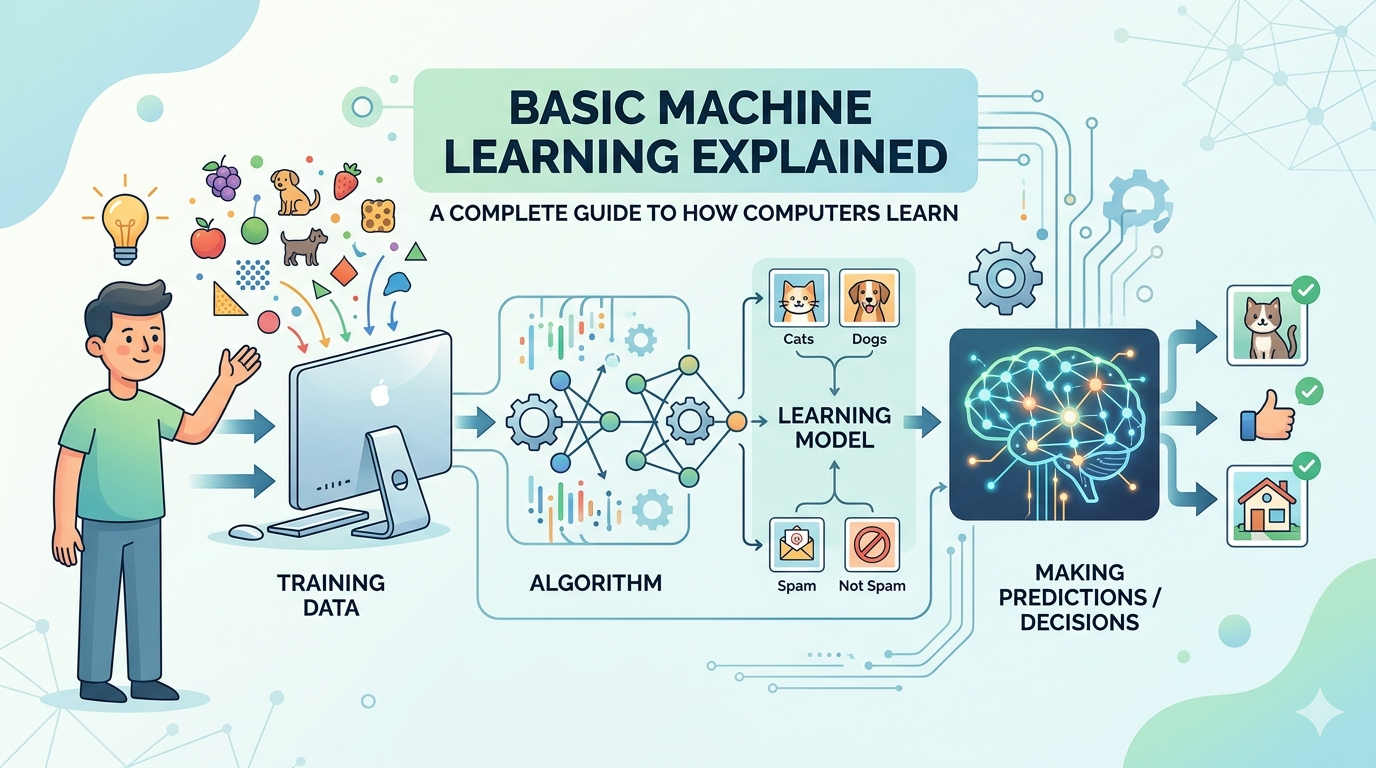
Basic Machine Learning Explained for Beginners: A Complete Guide to How Computers Learn
Table of Contents
Imagine you are teaching a child to recognize an apple. You don’t explain the molecular structure of the fruit or provide a geometric blueprint. Instead, you show them an apple and say, “This is an apple.” Then you show them an orange and say, “This is not an apple.” After seeing enough examples, the child’s brain identifies the patterns the roundness, the red or green color, the stem and can eventually identify an apple they have never seen before.
This is exactly how Machine Learning (ML) works.
In the traditional world of computing, humans write specific instructions (code) for every action a computer takes. In the world of Machine Learning, we provide the data and the answers, and the computer figures out the instructions for itself.
In this comprehensive guide, we will demystify machine learning, explore its core types, look at real-world applications, and explain why this technology is reshaping our world.
What is Machine Learning?
At its simplest, Machine Learning is a branch of Artificial Intelligence (AI) that focuses on building systems that learn from data.
The formal definition, coined by pioneer Arthur Samuel in 1959, describes it as the “field of study that gives computers the ability to learn without being explicitly programmed.”
The Paradigm Shift: Traditional Programming vs. Machine Learning
To understand ML, you must understand how it differs from traditional software development.
- Traditional Programming: A programmer writes a set of rules (If X happens, then do Y). The computer follows these rules strictly to produce an output. If the scenario changes slightly and there isn’t a rule for it, the computer fails.
- Machine Learning: We feed the computer vast amounts of data (the input) and the desired results (the output). The ML algorithm processes this information to create a model. This model is essentially a complex mathematical formula that can predict the output for new, unseen data.
Essentially, machine learning is about pattern recognition.
How Does Machine Learning Work? (The 5-Step Process)
Machine learning isn’t magic; it’s a systematic process involving data and mathematics. Here is the high-level workflow of an ML project:
1. Data Collection
Data is the fuel for machine learning. To train a model, you need high-quality data. This could be images, text, numbers, or user behavior logs. The more relevant data you have, the better your “machine” can learn.
2. Data Preparation (Cleaning)
Raw data is often messy. It may have missing values, duplicates, or errors. Data scientists spend about 80% of their time cleaning data—standardizing formats and removing “noise” that might confuse the algorithm.
3. Choosing a Model
Depending on the problem you are trying to solve (predicting a price, identifying a face, or grouping customers), you choose a specific algorithm. There are dozens of types, ranging from simple Linear Regression to complex Neural Networks.
4. Training the Model
This is where the actual “learning” happens. You feed your prepared data into the algorithm. The algorithm makes guesses, checks how wrong those guesses are (using a “loss function”), and adjusts its internal parameters to get closer to the right answer. This cycle repeats thousands or millions of times.
5. Evaluation and Tuning
Once trained, you test the model on data it has never seen before. If the accuracy is low, you go back and tune the “hyperparameters” (the settings of the algorithm) or provide more data until the model performs reliably.
The Three Main Types of Machine Learning
Not all learning is the same. Depending on the goal and the type of data available, machine learning is generally categorized into three main types:
1. Supervised Learning (The “Teacher” Model)
Supervised learning is the most common type of ML. It’s called “supervised” because the process is like a student learning under the supervision of a teacher.
In this scenario, the data is labeled. This means the input data is already tagged with the correct answer.
- Example: You show the computer 10,000 photos of cats and 10,000 photos of dogs. Each photo is labeled “Cat” or “Dog.”
- Goal: To predict the label of a new, unlabeled image.
- Common Use Cases: Email spam detection, credit scoring, image recognition.
2. Unsupervised Learning (Finding Hidden Patterns)
In unsupervised learning, the data is unlabeled. The computer is given a pile of data and told, “Find something interesting here.”
Since there are no “correct answers” provided, the algorithm looks for similarities, differences, and patterns.
- Example: You give a machine a list of 1 million grocery store customers and their purchase history. The machine might group them into “budget shoppers,” “health enthusiasts,” and “bulk buyers.”
- Goal: To discover hidden structures in data (Clustering).
- Common Use Cases: Customer segmentation, anomaly detection (fraud), recommendation engines.
3. Reinforcement Learning (Trial and Error)
Reinforcement learning is based on the concept of “rewards” and “punishments.” It is very similar to how we train a dog.
An agent (the AI) interacts with an environment. It takes an action, and receives either a reward (positive feedback) or a penalty (negative feedback). Over time, the agent learns to maximize its rewards.
- Example: An AI learning to play a video game. If it stays alive, it gets points (reward). If it hits an obstacle, it dies (penalty). Eventually, it learns the perfect path to win.
- Goal: To learn a series of actions that lead to the best outcome.
- Common Use Cases: Self-driving cars, robotics, gaming AI (like AlphaGo).
Key Machine Learning Terminology for Beginners
To navigate the world of ML, you need to speak the language. Here are the most important terms:
- Algorithm: The mathematical procedure or set of rules used to process data.
- Model: The output of a machine learning algorithm after it has been trained on data.
- Features: The individual independent variables that act as input (e.g., in predicting house prices, features would be square footage, number of bedrooms, and location).
- Label/Target: The thing you are trying to predict (e.g., the actual price of the house).
- Overfitting: A common mistake where a model learns the training data too well, including its random noise. It performs great on old data but fails on new data.
- Underfitting: When the model is too simple to capture the underlying pattern in the data.
- Deep Learning: A subfield of ML that uses “Neural Networks” with many layers to solve highly complex problems like voice recognition.
Common Machine Learning Algorithms You Should Know
While there are hundreds of algorithms, a few do most of the heavy lifting in the industry:
Linear Regression
Used for predicting a continuous numerical value. If you want to predict how much a car will sell for based on its age and mileage, you use Linear Regression.
Logistic Regression
Despite the name, this is used for classification (Yes/No). Is this email spam? Is this transaction fraudulent? Does this patient have a specific disease?
Decision Trees
A flow-chart-like structure where the machine makes decisions based on certain conditions. It’s easy to visualize and understand, making it popular for business logic.
K-Nearest Neighbors (KNN)
This algorithm classifies a data point based on how its neighbors are classified. If most of your “neighbors” (similar data points) are “Apples,” you are likely an “Apple” too.
Random Forest
This is an “ensemble” method that combines multiple Decision Trees to reach a more accurate and stable prediction. It’s like asking a dozen experts for their opinion and taking the average.
Why is Machine Learning Important?
You might not realize it, but you interact with machine learning dozens of times every day. It has moved from the realm of science fiction into the fabric of our daily lives.
Personalization
When Netflix suggests a movie you might like, or Spotify creates a “Discover Weekly” playlist, that is machine learning analyzing your past behavior to predict your future preferences.
Safety and Security
Banks use ML to monitor millions of transactions in real-time. If you live in New York and your card is suddenly used in a different country for a luxury purchase, ML flags it as “out of pattern” and blocks the transaction.
Healthcare
ML models are now helping doctors identify tumors in X-rays with higher accuracy than human radiologists. They can also predict which patients are at high risk of developing chronic conditions by analyzing years of medical history.
Efficiency and Automation
From self-driving cars to thermostats that learn when you are home to save energy (like Nest), machine learning is making our world more efficient and reducing human error.
Challenges and Ethics in Machine Learning
As powerful as ML is, it is not without its flaws. Understanding these challenges is crucial for anyone entering the field.
1. Data Bias
A machine is only as good as the data it is fed. If the training data contains human biases (e.g., historical hiring bias), the ML model will learn and amplify those biases. This has led to controversies in facial recognition and AI-driven hiring tools.
2. The “Black Box” Problem
Deep learning models are often so complex that even the engineers who built them can’t explain why the machine made a specific decision. This lack of “explainability” is a major hurdle in fields like law and medicine.
3. Data Privacy
Machine learning requires massive amounts of data, often personal. Striking a balance between building helpful AI and protecting user privacy is one of the biggest challenges of the 21st century.
How to Get Started with Machine Learning
If you are a beginner looking to dive deeper, here is a roadmap:
- Learn Python: Python is the “lingua franca” of machine learning due to its simple syntax and powerful libraries.
- Understand Basic Statistics: You don’t need to be a mathematician, but you should understand concepts like mean, median, standard deviation, and probability.
- Explore Libraries: Start playing with libraries like Scikit-Learn (for basic ML), Pandas (for data manipulation), and Matplotlib (for data visualization).
- Take a Course: Platforms like Coursera (Andrew Ng’s courses are legendary), Udemy, and fast.ai offer excellent beginner-to-advanced paths.
- Build Projects: The best way to learn is by doing. Try predicting house prices or classifying flowers using the famous “Iris dataset.”
FAQ: Frequently Asked Questions about Machine Learning
What is the difference between AI and Machine Learning?
Artificial Intelligence (AI) is the broad concept of machines being able to carry out tasks in a way that we would consider “smart.” Machine Learning is a specific subset of AI that focuses on the idea that we can give machines access to data and let them learn for themselves.
Do I need to be a math genius to learn ML?
No. While ML is based on linear algebra, calculus, and statistics, most modern tools and libraries handle the complex math for you. You need a solid understanding of the concepts, but you don’t necessarily need to solve complex equations by hand.
Is Machine Learning the same as Deep Learning?
No. Deep Learning is a specific type of Machine Learning. It uses “Artificial Neural Networks” with many layers (hence the “deep”) to process complex data like images and sound. Think of it as a specialized, more powerful version of ML.
Which programming language is best for Machine Learning?
Python is the undisputed king of ML. However, R is also popular for statistical analysis, and C++ is used in cases where high-performance and speed are critical (like in self-driving cars).
Can Machine Learning replace humans?
ML is designed to automate repetitive tasks and find patterns in data that humans might miss. While it may change the nature of many jobs, it is largely viewed as a tool to augment human intelligence rather than replace it entirely, especially in areas requiring empathy, creativity, and complex strategy.
Is Machine Learning expensive?
It can be. While many software tools are open-source and free, the computational power required to train massive models (like GPT-4) can cost millions of dollars. However, for small-scale business applications, it is more affordable than ever.
Conclusion
Machine Learning is no longer a niche academic subject; it is the engine driving the modern digital economy. By shifting from “giving orders” to “showing examples,” we have unlocked a level of automation that was unthinkable 20 years ago.
Whether you are a business leader looking to optimize operations, a student looking for a future-proof career, or simply a curious individual, understanding the basics of machine learning is essential. We are moving toward a world where “Data + Algorithms” will influence every decision we make. By understanding how these systems learn, we can better navigate the opportunities and challenges they bring.
The journey into machine learning starts with a single dataset. What will you teach your machine today?