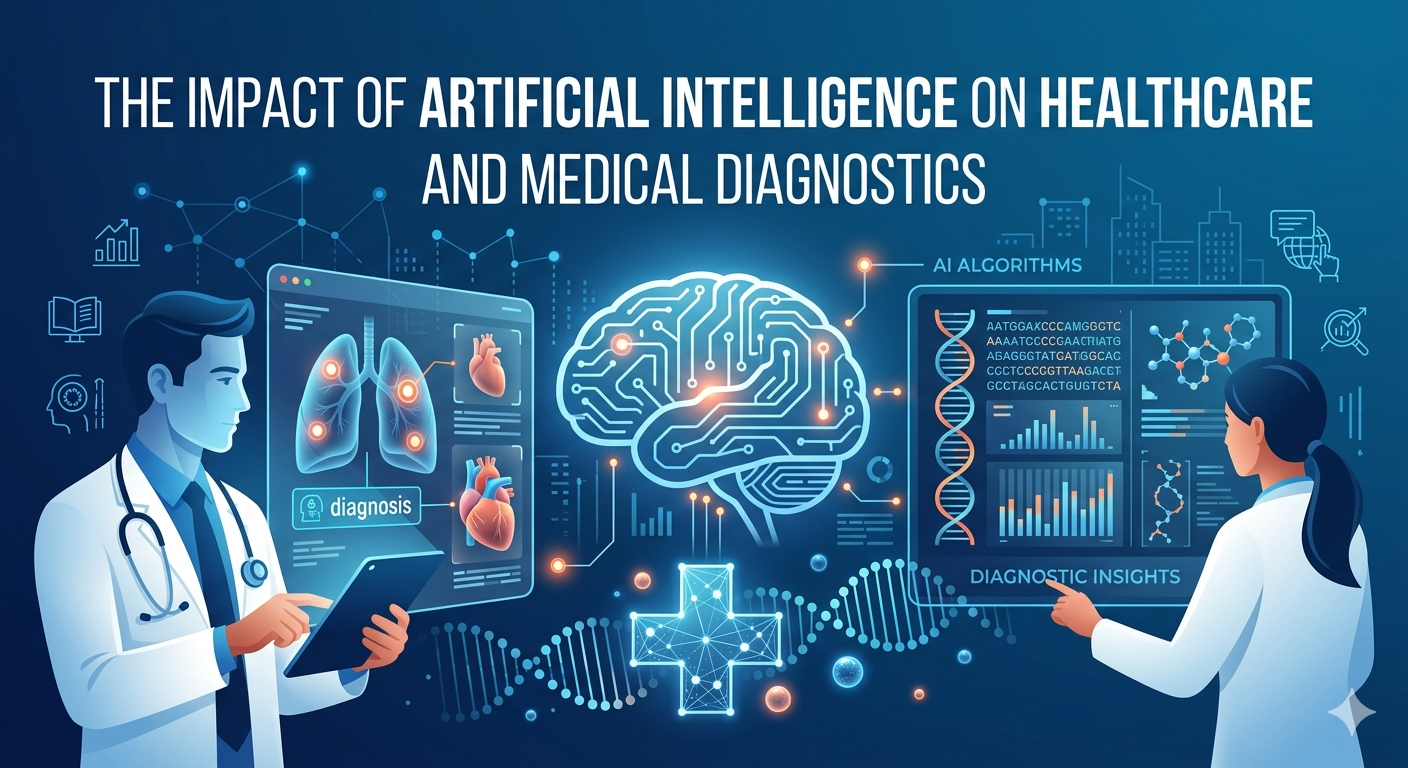
The Impact of Artificial Intelligence on Healthcare and Medical Diagnostics
Table of Contents
The Healthcare industry is currently undergoing a monumental shift, driven by the rapid evolution of technology. At the heart of this transformation is Artificial Intelligence in Healthcare, a field that has moved from the realms of science fiction to the front lines of clinical practice. Today, AI is not just a tool for researchers; it is a critical partner for doctors, nurses, and hospital administrators.
From identifying life-threatening tumors on an X-ray to predicting which patients are at risk of heart failure, medical AI technology is enhancing the precision, speed, and efficiency of medical services This article provides a comprehensive look at how AI is reshaping the medical landscape and what the future holds for this digital revolution.
What Is Artificial Intelligence in Healthcare?
In its simplest form, **Artificial Intelligence in Healthcare** refers to the use of complex algorithms and software to emulate human cognition in the analysis, interpretation, and comprehension of complicated medical and healthcare data. Unlike traditional technologies, AI has the unique ability to “learn” by processing massive datasets, identifying patterns that are often invisible to the human eye.
The backbone of AI in healthcare consists of several sub-fields:
Machine Learning (ML): This allows systems to learn from data and improve their performance over time without being explicitly programmed for every task.
Natural Language Processing (NLP): This enables computers to understand and interpret human language, which is essential for analyzing clinical notes and medical records.
Computer Vision: This technology allows AI to “see” and interpret visual data, such as medical images.
Deep Learning: A more advanced form of ML that uses neural networks to solve highly complex problems, such as genomic sequencing.
By integrating these technologies, healthcare providers can offer more personalized treatments and streamline administrative tasks, allowing more time for direct patient interaction.
AI in Medical Diagnostics
One of the most impactful applications of medical AI technology is in the field of diagnostics. In traditional medicine, diagnosis relies heavily on a clinician’s experience and the interpretation of symptoms. However, human error and cognitive bias can sometimes lead to misdiagnosis or delayed treatment.
AI diagnostics are changing this paradigm. Algorithms can analyze a patient’s entire medical history, genetic profile, and current symptoms in seconds. For instance, AI-driven tools are now being used to detect early-stage cancers, such as melanoma or lung cancer, with a level of accuracy that often rivals or exceeds that of veteran specialists.
AI in Medical Imaging
Radiology and pathology are perhaps the sectors most transformed by AI medical imaging In a typical hospital setting, radiologists are often overwhelmed by the sheer volume of scans they must review daily. This can lead to fatigue and oversight.
AI serves as a powerful assistant in the following ways:
Speed and Prioritization: AI algorithms can pre-scan thousands of images (MRIs, CT scans, and X-rays) to flag abnormalities. This allows radiologists to prioritize the most urgent cases, such as an internal hemorrhage or a stroke, where every second counts.
Enhanced Precision: AI can detect micro-calcifications in mammograms or tiny nodules in lung scans that are barely a few millimeters in size.
Consistency: Unlike humans, AI does not suffer from “eye fatigue.” It provides a consistent level of scrutiny to the first image of the day and the last.
By reducing the time spent on manual screening, AI medical imaging allows specialists to focus on the complex task of treatment planning and patient consultation.
Predictive Analytics and Disease Prevention
The old saying “prevention is better than cure” has never been truer than in the age of predictive analytics in healthcare Rather than just treating diseases after they manifest, AI helps providers look into the future.
By analyzing historical patient data and real-time monitoring stats, AI can identify patients at high risk of developing chronic conditions like Type 2 diabetes or hypertension. Predictive models can also forecast “hospital readmission” risks, helping doctors decide if a patient is truly ready to go home or if they need more intensive follow up care.
During the COVID-19 pandemic, predictive analytics proved vital. AI models were used to predict infection surges, hospital bed shortages, and even which patients were most likely to require ventilator support. This data-driven approach allows for better resource allocation and proactive intervention, ultimately saving lives.
AI for Improving Patient Care
While much of the focus is on the technical side, Artificial Intelligence in Healthcare is also making the patient experience more human and accessible.
Virtual Health Assistants and Chatbots
AI-powered chatbots are now the first point of contact for many patients. These tools can triaged symptoms, answer common health questions, and even schedule appointments. This reduces the burden on administrative staff and provides patients with 24/7 access to information.
Personalized Medicine
Every human body is different. AI allows for “Precision Medicine,” where treatments are tailored to an individual’s genetic makeup and lifestyle. For example, AI can predict how a specific patient will react to a certain chemotherapy drug, allowing oncologists to choose the most effective treatment with the fewest side effects.
Remote Patient Monitoring
With the rise of wearable devices like smartwatches, AI can monitor a patient’s vitals (heart rate, oxygen levels, sleep patterns) in real-time. If the AI detects an anomaly such as an irregular heart rhythm it can immediately alert the patient and their doctor, preventing a potential medical emergency.
The Rise of Generative AI in Healthcare Operations
Beyond clinical applications, the rise of generative AI tools is revolutionizing the “business” of healthcare. Just as generative AI is used for content creation, design, and coding in the tech world, it is being adapted for medical environments.
Content Creation and Documentation: Doctors often spend hours on paperwork. Generative AI can take voice-recorded notes and turn them into structured medical reports, summarizing patient visits instantly. This “content creation” saves hours of administrative labor.
Medical Coding and Billing:Accuracy in medical coding is essential for hospital revenue. AI tools can automate the coding process by reading physician notes and assigning the correct billing codes, reducing errors and insurance denials.
Business Automation: AI-driven automation handles repetitive tasks like processing insurance claims, managing supply chains, and optimizing staff schedules. This ensures that hospital resources are used efficiently.
Software Design and Development: Generative AI is even helping developers write the code for new medical apps and diagnostic tools, accelerating the pace of innovation in medical AI technology.
Benefits of Artificial Intelligence in Healthcare
The integration of AI into the medical sector offers a wide array of benefits that extend to patients, providers, and the economy.
1. Reduced Costs: By automating administrative tasks and improving diagnostic accuracy, AI could save the US healthcare economy an estimated $150 billion annually by 2026.
2. Increased Efficiency: AI can process data at speeds impossible for humans, leading to faster results for patients and less burnout for medical professionals.
3. Improved Outcomes: Early detection and personalized treatment plans directly lead to higher survival rates and better qualities of life for patients.
4. Accessibility: AI-driven telemedicine and chatbots make healthcare advice accessible to people in remote areas or those with limited mobility.
5. Drug Discovery: AI is drastically shortening the time it takes to develop new medications by simulating how different drug compounds will interact with the human body.
Challenges and Ethical Concerns
Despite the incredible potential of Artificial Intelligence in Healthcare, several hurdles must be addressed to ensure its safe and ethical implementation.
Data Privacy and Security
Healthcare data is highly sensitive. The use of AI requires massive datasets to train algorithms, raising concerns about how patient data is stored, shared, and protected against cyberattacks. Compliance with regulations like HIPAA is paramount.
Algorithmic Bias
If the data used to train an AI is biased (e.g., if it lacks diversity in terms of race, gender, or age), the AI’s conclusions may also be biased. This could lead to disparities in care for minority groups. Ensuring “algorithmic fairness” is a major focus for developers today.
The “Black Box” Problem
Some AI models are so complex that even their creators cannot fully explain how they reached a specific conclusion. In a field where lives are at stake, “explainability” is crucial. Doctors must be able to understand and trust the AI’s reasoning before making clinical decisions.
Future of AI in Healthcare
The future of medical AI technology is incredibly bright. We are moving toward a world of Ambient Intelligence, where healthcare is woven into the fabric of our daily lives.
Imagine a “Smart Hospital” where AI monitors every patient’s movement to prevent falls, or AI-powered robotic surgeons that can perform complex procedures with sub millimeter precision We may soon see AI that can predict the onset of Alzheimer’s disease years before symptoms appear, or the use of “Digital Twins” virtual models of a patient to test treatments before they are administered in real life.
As AI continues to learn and evolve, the focus will shift from treating sickness to maintaining “wellness.” The transition from reactive to proactive medicine will likely be the greatest legacy of Artificial Intelligence in Healthcare.
Conclusion
Artificial Intelligence in Healthcare is no longer a futuristic concept; it is a current reality that is saving lives every day By revolutionizing AI diagnostics, enhancing AI medical imaging, and powering predictive analytics in healthcare, this technology is making medicine more precise, efficient, and personalized While challenges regarding ethics and data privacy remain, the benefits of AI far outweigh the risks As we continue to integrate generative AI for automation and content creation within the medical field, we move closer to a healthcare system that is truly patient centric The collaboration between human intelligence and artificial intelligence marks the beginning of a new era in medicine one where the possibilities for healing are virtually limitless.
Frequently Asked Questions (FAQ)
1. Will AI replace doctors in the future?
No, AI is designed to augment the capabilities of doctors, not replace them While AI can process data and identify patterns faster, it lacks the empathy, ethical judgment, and complex clinical reasoning that human healthcare providers offer.
2. Is my medical data safe with AI?
Healthcare providers and AI developers must adhere to strict data protection laws like HIPAA and GDPR While no system is 100% immune to risks, the industry uses advanced encryption and anonymization techniques to protect patient privacy.
3. How does AI help in early cancer detection?
AI uses deep learning to analyze medical images (like mammograms or skin scans) It compares these images against a massive database of known cases, allowing it to spot tiny irregularities or patterns that may indicate the earliest stages of cancer, often before they are visible to the human eye.
4. What are the main benefits of predictive analytics in healthcare?
Predictive analytics helps in identifying at-risk patients, preventing hospital readmissions, managing chronic diseases more effectively, and optimizing hospital resources by forecasting patient surges.
5. How is generative AI used in hospitals?
Generative AI is used to automate administrative tasks, such as summarizing patient notes, generating medical reports, creating educational content for patients, and streamlining the billing and coding process.